
Development Boards
IoT Development Board Selection
ESP and STM32 boards cover connected devices, sensor input, control output, and low-level firmware work. The final choice should be based on maintainability after installation, not only on the specification table.
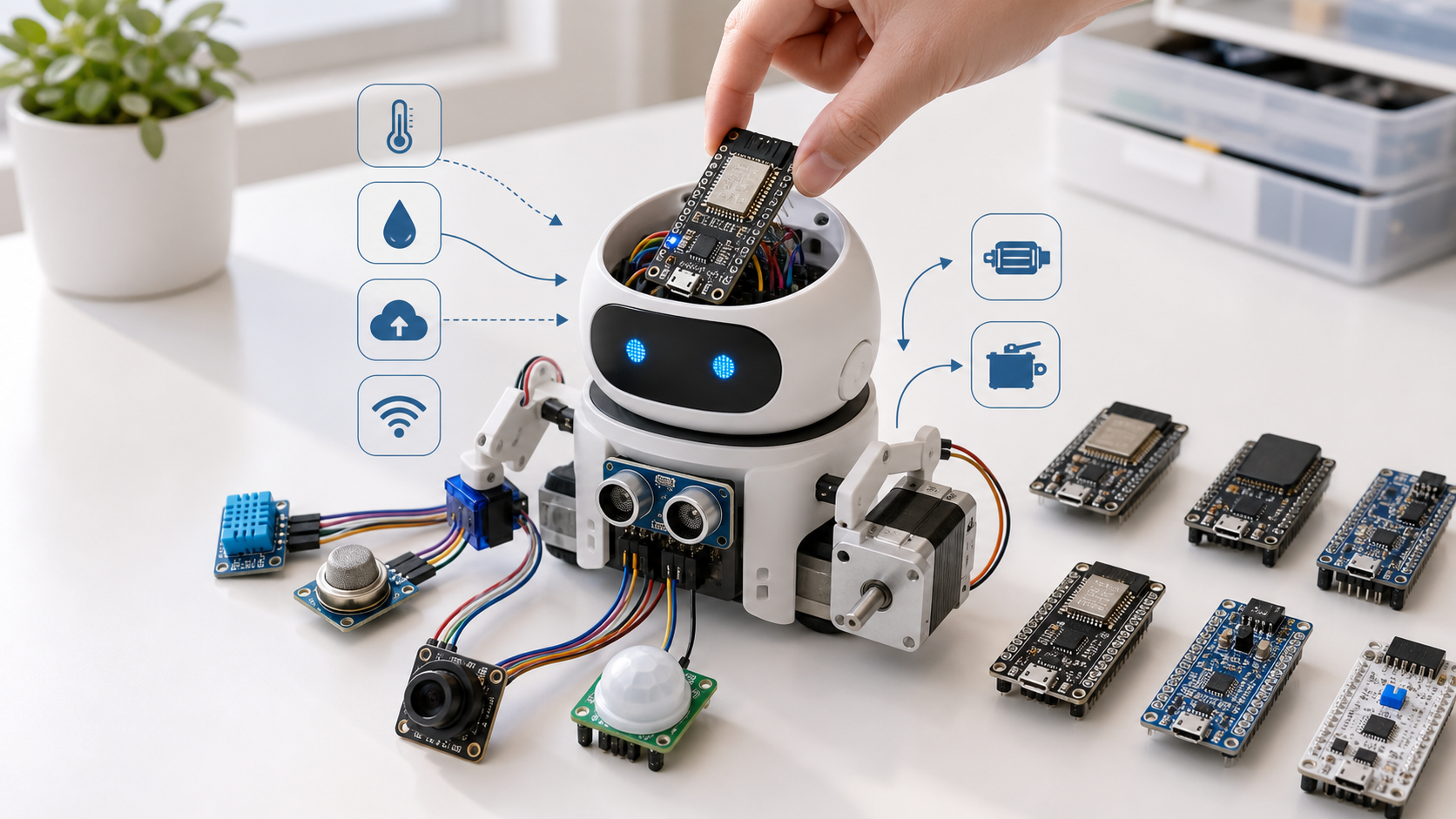
Quick board choices
ESP8266
A common Wi-Fi board for sensor nodes, remote switches, and simple control devices. It can still be practical when the job is small, Wi-Fi-only, and cost-sensitive.
ESP32
A more capable family with Bluetooth, more GPIO, dual-core variants, and broader memory options. Choose it when BLE setup, multiple sensors, displays, or memory headroom matter.
ESP32-C3
A compact RISC-V based option often considered for low-power connected devices. It is useful when a newer platform is preferred but the build remains simple.
ESP32-S3
A candidate for USB, camera, AI-adjacent workloads, and memory-heavy builds. TFT screens, image-related projects, and PSRAM-dependent code benefit from this family.
STM32 Blue Pill
A 3.3V STM32F103C8T6 board for SWD debugging, ADC, UART, SPI, I2C, timers, and low-level firmware practice. Treat it as a control-learning board, not a Wi-Fi IoT shortcut.
How to choose a board in real builds
Do not choose a development board from the specification table alone. Power source, installation location, radio requirements, GPIO count, library support, and replacement availability matter in real deployments. A sensor node, a display hub, a battery device, and a low-level controller need different boards.
The ESP8266 usefulness note explains when a simple Wi-Fi board is enough. If smartphone provisioning, BLE sensors, or a broader wireless plan is required, the ESP32 wireless trends note gives better context.
Checklist before wiring
- Confirm whether sensors and modules use 3.3V logic.
- Avoid using boot-sensitive pins for loads that change state during startup.
- Test with the final power adapter, not only USB power.
- Check flash and partition headroom if OTA or local logs are needed.
- Make sure the board can still be sourced if you need more units later.
When to avoid a board
A popular board is not automatically the right board. Avoid a board when GPIO headroom, power behavior, radio support, or long-term replacement does not match the actual installation.
Common board-selection mistakes
The most common mistake is choosing the board that is already on the desk. ESP8266 is still excellent for simple Wi-Fi nodes, but it becomes tight when the design needs Bluetooth, many GPIO pins, multiple UART sensors, camera modules, or large local buffers.
Another mistake is judging a board only by CPU speed. Field reliability depends on power input tolerance, USB-serial stability, antenna placement, boot-pin restrictions, available flash, and whether the same board can be purchased again when more units are needed.
For installed devices, the board choice should be written down with the reason: low-cost sensor node, BLE setup flow, display controller, battery node, or gateway. That note prevents future repairs from becoming guesswork.
Installation conditions come before the specification table
Choosing a development board only by CPU speed or by the newest chip often creates trouble in the field. The decision should also include how many sensors are attached, how many UART ports are needed, whether BLE setup is required, whether the antenna will be blocked inside the case, and whether the same board can still be purchased months later.
ESP8266 is still a realistic choice for simple Wi-Fi sensor nodes. For devices that read one value and send it to a central hub, such as door state, rain detection, refrigerator temperature, or basic room data, its price and accumulated examples remain useful. When BLE setup, multiple serial sensors, larger buffers, or display control are required, an ESP32-family board is usually safer.
The board notes in this section are not written to declare one board as universally better. They are written to answer which board is less risky in a given situation. When the part choice is clear, wiring, power design, and firmware update strategy become easier to keep consistent.